Where does your lumber come from?
From forest to job site.
Nov 1, 2026 · @Russell DeVane
Key Take Aways:
- About 70% of U.S. lumber is supplied from domestic timberlands.
- Canada is the largest supplier outside the U.S.
- Oregon is the countries single largest lumber state providing about 16.5% of U.S. production.
- West provides a little over a third of the national total.
- Alabama & Georgia provide most of the southern yellow pine produced in the U.S.
Introduction
Most of us never think about where our building material comes from. We take it for granted that the local yard or big-box store will have racks of studs and joists ready to go at our beck and call. But once the question is proposed, we don't need to be blessed with an abundance of curiosity to give pause and acknowledge - that is a good question.
Most of the lumber in an American house grew on a private tree farm in the South or the Pacific Northwest - that is, from domestic forests. Close to 30% comes from Canada, mostly spruce, pine and fir. How can you tell where your lumber came from? Every stud carries a grade stamp: a small inked block with the species group, the grade and a mill number. Follow those stamps back and the map of where your "house" came from turns out to be surprisingly concentrated.
Just how much lumber are we talking about. For scale, the U.S. used about 95 million cubic meters of softwood lumber in 2023, and domestic mills sawed about 64 million of it, according to the USDA Forest Service. Here's where that wood grows.
First, what counts as softwood?
Softwood is a botanical label, not a measure of hardness. It means lumber from conifers, the needle-and-cone trees like pine, spruce, fir and hemlock. Hardwood comes from broadleaf trees like oak, maple and poplar. Southern yellow pine is harder than some hardwoods, and balsa, the model-airplane wood, is technically a hardwood.
Almost every framing member is softwood, for a few practical reasons:
- Straight, tall trunks. Conifers grow a single straight stem, so mills can cut long, uniform studs, joists and rafters with little waste.
- Fast growth. Plantation pine reaches sawlog size in a few decades, which keeps supply large and prices low.
- Strength for the weight. Softwood framing is stiff and strong relative to how light it is, and it's easy to cut and nail on site.
- Standardized grades. Softwood dimension lumber is graded and stamped to national rules, so engineers and inspectors can rely on published span tables.
Hardwoods, on the other hand, go where looks and wear matter: floors, cabinets, trim and furniture. By volume, softwood is about 90% of the lumber the U.S. uses.
Which states do the sawing?
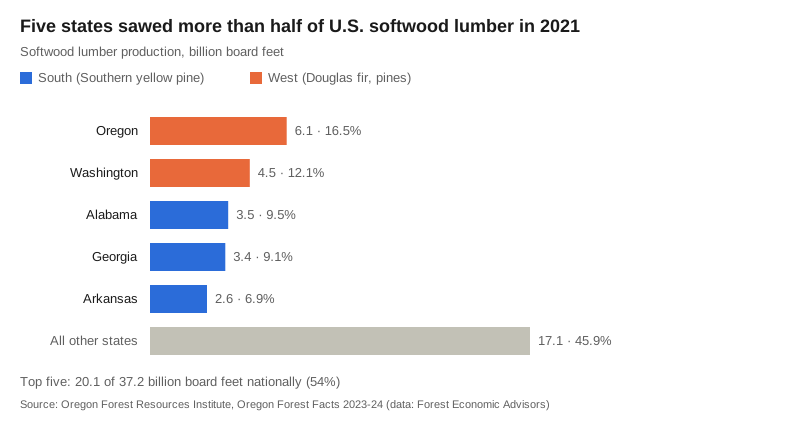
Two regions dominate: the Pacific Northwest, led by Oregon and Washington, and the Southern pine belt, led by Alabama, Georgia and Arkansas. In the last published state ranking with ten states (2015), Mississippi, California, Idaho, North Carolina and Texas rounded out the top ten.
The Southern pine belt: America's lumberyard
The South sawed about 62% of U.S. softwood lumber in 2023, 39.2 million cubic meters, per the Forest Service. The belt runs from East Texas through Arkansas, Louisiana, Mississippi, Alabama and Georgia into the Carolinas and Virginia.
The tree is southern yellow pine, mainly loblolly, grown in rows like a slow crop. Plantations cover less than a fifth of southern forest area but supply about four-fifths of the region's softwood removals, according to the Congressional Research Service. A loblolly stand can go from seedling to sawlog in roughly 25 to 35 years.
If you've built a deck in Ohio, you've almost certainly handled this wood. Southern pine takes preservative treatment well, which is why it dominates the pressure-treated racks at Midwest yards.
Alabama and Georgia lead the region, each sawing about 3.4 to 3.5 billion board feet of lumber in 2021.
The Pacific Northwest: big trees, big mills
Oregon is the country's single largest lumber state, sawing 6.1 billion board feet in 2021, about 16.5% of U.S. production. Washington ranked second at 4.5 billion, per the Oregon Forest Resources Institute, a state agency, citing Forest Economic Advisors.
The signature species here is Douglas fir, dominant west of the Cascades and prized for strength in joists, beams and headers. East of the mountains, and on into Idaho and Montana, the mix shifts to ponderosa and lodgepole pine, Engelmann spruce and true firs.
The West sawed about 24.1 million cubic meters in 2023, a little over a third of the national total, and its share has been slipping as Southern mills expand.
Who owns the trees? Mostly families and companies
About 90% of the wood cut from U.S. forests comes from private land: 57% from families and individuals and 33% from businesses, per the Forest Service's Forest Resources of the United States, 2017 (as summarized by the National Association of State Foresters).
National forests are a small slice. The Forest Service sold an average of about 3 billion board feet of timber a year from fiscal 2014 to 2023, according to the Government Accountability Office, across a 193-million-acre system.
Oregon shows the contrast best. The federal government manages 61% of the state's forest, yet about 76% of Oregon's timber harvest comes from private timberland (OFRI). The 2x4 in your wall almost certainly came off a working tree farm, not a national forest.
Closer to home: Ohio grows hardwoods
Ohio has about 7.75 million acres of forest, roughly 30% of the state, per the Forest Service's Forests of Ohio, 2020. That's a comeback story: forest cover bottomed out near 10% around 1910 before farmland reverted to woods (Ohio Forests 2016).
Ohio's woods are almost entirely broadleaf. About 96% of the state's forest is deciduous (USDA Forest Service), and yellow-poplar is the leading sawtimber species by volume, followed by hickory, red maple, ash and white oak (Ohio's Forests 2011). So the framing in a Cincinnati house is shipped in, but the oak floors, poplar trim and maple cabinet doors may well be from the Appalachian hills a couple of hours east.
Like the South, Ohio's forest is private: 85% of forest land, with families and individuals holding 70% (Forest Service). The federal share, mostly the Wayne National Forest in the southeast, is about 355,000 acres.
Beyond the border: Canada's boreal spruce and a little Europe
Canada supplied about 82% of U.S. softwood lumber imports in 2025, 24.6 million cubic meters, per U.S. Customs data (compiled by Wood Central). Most of it is spruce-pine-fir from the boreal forests of British Columbia, Alberta, Quebec and Ontario, much of it grown on provincially owned Crown land, the opposite of the private U.S. model.
The rest arrives by ship: German and Swedish spruce, radiata pine from Chile and New Zealand, and smaller lots from Brazil, Austria and the Baltics. Together those overseas suppliers make up less than a fifth of imports.
That Crown-land (publicly owned land) difference is the root of a 40-year trade fight over Canadian timber pricing, and the reason lumber prices have become a policy story. That's the subject of a different discussion.
Sources
- USDA Forest Service, U.S. Forest Products Annual Market Review and Prospects, 2022–2026
- USDA Forest Service, Forests of Ohio, 2020 (FS-341)
- USDA Forest Service, Ohio Forests 2016 (NRS-118)
- USDA Forest Service, Ohio's Forests 2011 (NRS-90)
- USDA Forest Service, Ohio forest resource update (FS-171)
- USDA Forest Service, Ohio Forest Health Highlights 2012
- Congressional Research Service, U.S. Forest Ownership and Management (R46976)
- GAO, Forest Service Timber Sales in Fiscal Years 2014–2023 (GAO-25-107496)
- Oregon Forest Resources Institute, Oregon Forest Facts 2023–24 (state agency; lumber by state from Forest Economic Advisors)
- Oregon Forest Resources Institute, Oregon is number one (citing USDA Forest Service, Forest Resources of the United States, 2007)
- National Association of State Foresters, Markets for Wood Products (citing Forest Resources of the United States, 2017)
- Wood Central, 2025 U.S. softwood imports by country (from U.S. Customs data)
State-level lumber output beyond the top five isn't published by a federal agency; the Forest Service's Forest Resources of the United States, 2022 has state timber removals if you want a fully federal state ranking.